

Zion Lutheran Church in Imperial, Neb., became a regional food warehouse with assembly lines of dozens of volunteers that packaged tens of thousands Mercy Meals during a Mega Pack event, Oct. 2-3
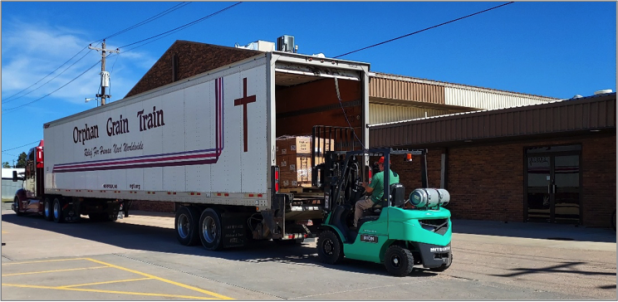
At the Oct. 2-3 Imperial, Neb. Mercy Meal Mega Pack, boxed meal bags were stacked on pallets and forklifted into the Orphan Grain Train truck for transporting to Norfolk, Neb.
Lutheran churches join forces for ‘Mercy Meal’ Mega Pack event
By JR Krueger
High Plains News North Correspondent
The Rocky Mountain Orphan Grain Train (OGT) division in Julesburg, Colo., collaborated with Mercy Meals of Southwest Nebraska to package meals at Zion Lutheran Church in Imperial, Neb., Friday Oct. 2, and Saturday Oct. 3. Local area participants came from Lutheran Church-Missouri Synod congregations in Grant, Imperial, and Wauneta.
A Mercy Meal is a small plastic bag filled with rice, dehydrated soy, dehydrated vegetables, and a vitamin- and mineral-infused flavor pack. One pack contains six one-cup servings after the contents are boiled in water. A Mega Pack event utilizes dozens of volunteers to package tens of thousands of meals on one day.
Mercy Meals of SW Nebraska is a 100 percent volunteer-run non-profit organization that packages nourishing food delivered by Orphan Grain Train to hungry people worldwide. Over 2,251,278 meals have been packaged since 2012.
Orphan Grain Train is a Christian volunteer network that ships donated food, clothing, medical and other needed items to people in 74 different countries and 40 states in the USA.
After the Imperial event concluded, 87,264 meals were on their way to OGT’s headquarters in Norfolk, Neb.
Three Lutheran congregations decided to host the event – Zion, Imperial; Redeemer, Wauneta; and Saint Paul, Wauneta South Divide. It was organized by three women from these three congregations who are also board members of Mercy Meals of SW Nebraska - Mary Haarberg as the lead, Nanette Long, and Janet Keiser. Other board members are Pastor Keith Wellman, Jan Coone, and Laurie Kerchal.
Volunteers were recruited beginning a few months ahead of time and up until the event. Participants could sign up for 90-minute shifts. Several chose to work more than one shift. Some signed up for both days.
Supplies, equipment, and pallets of food bags were delivered to the church by an Orphan Grain Train truck.
On Friday, 55 volunteers from seven towns showed up to help get things set up. Flat cardboard sheets were propped up and strap taped for shipping boxes and then labelled. Plastic meal bags were labelled with stickers that identified Norfolk as the point of distribution, the packing date, and an expiration date of Oct. 2, 2029. Large plastic tote bins were filled with grain and dehydrated vegetables. Tables for assembly lines were set in place. Funnel cones and machines to seal the filled bags were distributed at the tables.
On Saturday, a steady stream of 175 enthusiastic volunteers from 19 towns and three states – Colorado, Nebraska, and Kansas – came and went throughout the day. The first step for new arrivals was to wash and sanitize hands, and then put on gloves, hairnets, and aprons.
People grouped up around filling stations that included a funnel in the center of a table, surrounded by the tubs of ingredients. One person would place the bag at the bottom of the funnel. Others then scooped up and dumped in the other ingredients.
When the bag was filled, a participant placed it on a nearby table where it was weighed to verify it was within an acceptable range. If too light, a little more rice was added. If too heavy, a little rice was removed. The weigher then gave the bag to the person who sealed up its end. The sealer placed the bag in the box.
Some volunteers served as “runners” who refilled bins when close to being emptied and also ensured that no one ran out of bags. In that way, the group didn’t break its rhythm by having to stop to restock. Others helped stack the boxes on pallets that were shrink wrapped before forklifted to the parking lot and loaded on the truck.
The mood was jovial while keeping up a fast pace to meet quotas per 90-minute session. People enjoyed getting to work alongside new acquaintances. When a session didn’t quite meet the quota, people readily agreed to work a little overtime. Each station needed 30 more bags. One of the groups achieved that in two minutes, or in other words, a pace of 15 bags per minute.
People left feeling rewarded for knowing that a hungry person somewhere in the world would be fed because they packed a bag of food for them.
Additional Nebraska communities lending volunteers were McCook, Culbertson, Enders, Big Springs, Champion, Brule, Benkelman, Palisade, Lamar, and Ogallala. The Kansas community was St. Francis. Colorado communities were Amherst, Holyoke, Haxtun, Sterling, Julesburg, Atwood, and Ovid.