
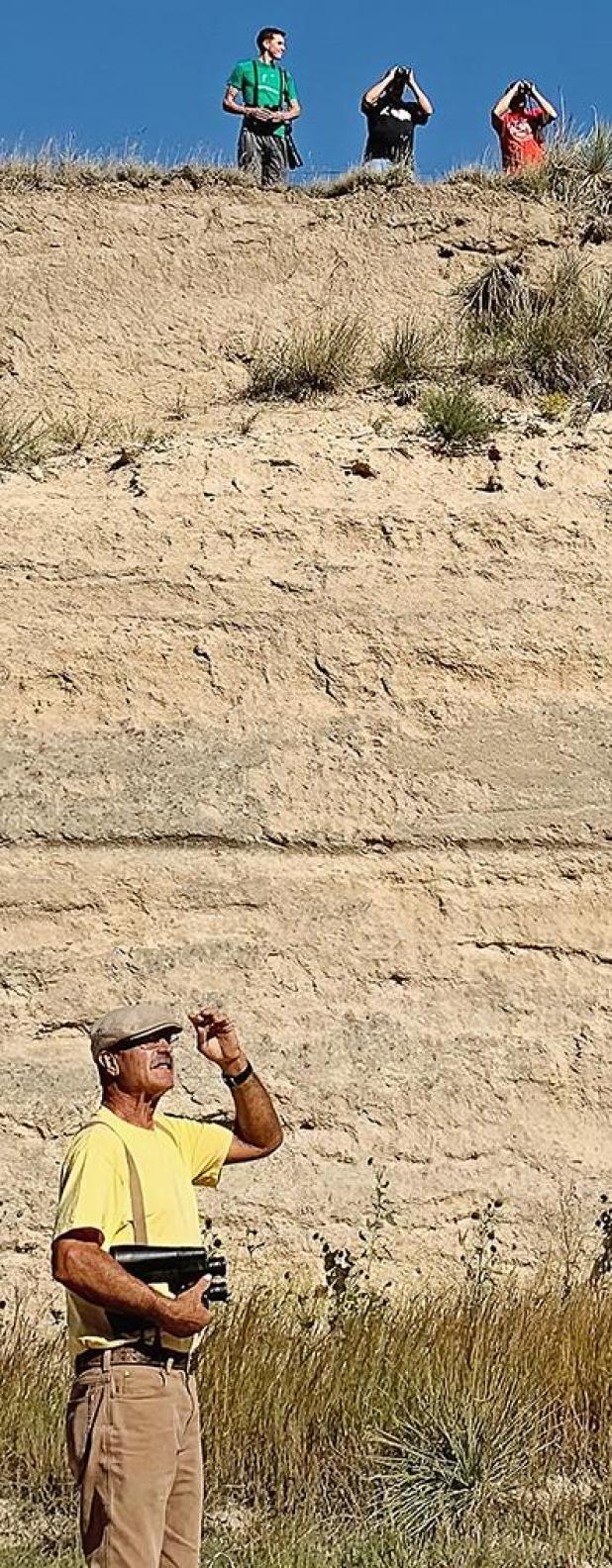
This group, including Fred Hoffmeister of Imperial, foreground, was looking for barn owl nest holes during one of the bird-watching field trips west of Enders Reservoir. (Courtesy photo)
Bird watchers find success in state’s southwest counties
More than 50 bird-watchers from Nebraska and surrounding states spent the Sept. 13-15 weekend in Imperial, as the Nebraska Ornithologists’ Union (NOU) held its semi-annual meeting.
Attendees spent the weekend looking for birds in Chase, Perkins, Dundy, Hitchcock and Hayes Counties.
Over the three days, they recorded at least 142 different bird species during their field trips.
One of the most sought-after birds was the white-winged dove, which has been seen regularly in a yard on 14th Street in Imperial, said Bill Flack of the NOU organization.
“Until the 1980s, this bird’s range only extended as far north as Texas, New Mexico, Arizona and California. In recent years, however, its range has expanded, and it’s now seen somewhat regularly in southwestern Nebraska,” he said.
However, it’s still rare in eastern Nebraska and Iowa, where many NOU members live, Flack added.
Another prize bird was the common tern, three of which were seen at Enders Reservoir. Despite the name, the bird is fairly uncommon in Nebraska—the North American birds breed in Canada, and most of them migrate farther east.
The birds at Enders were seen on the beach by the campground, and apparently weren’t bothered by the nearby campers and boaters, Flack said.
Although many of the NOU members have pursued birds throughout Nebraska, many others had never been in the southwest part of the state before, Flack added.
Several expressed delight with the birding opportunities and the hospitality they found in Imperial, “and declared their intention of returning soon,” Flack said.
The NOU’s meeting was headquartered at Imperial Inn, where there were also evening programs and meals served.