
Jan Schultz | The Imperial Republican
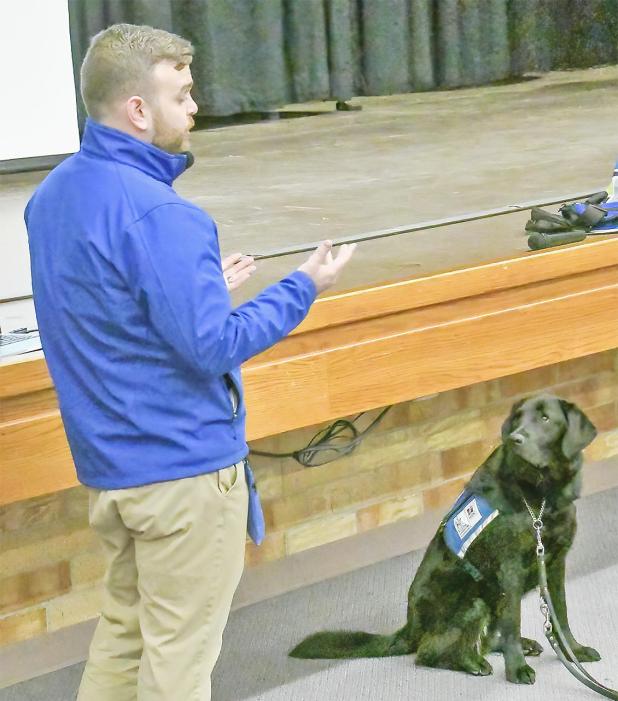
At last week’s evening program, Reed seems to be listening intently to Bryce Dolan, but spent a lot of the program sleeping after a busy day giving presentations.
Jan Schultz | The Imperial Republican
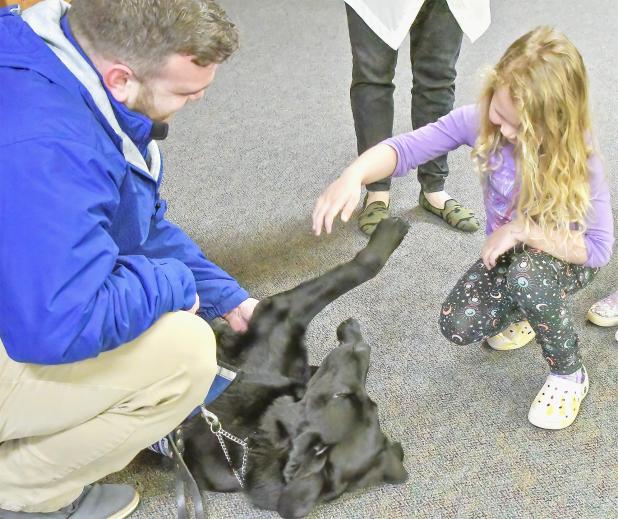
Youngsters at Rainbow Promise Preschool like Caysie Hudson enjoyed getting to know Reed up close in he and Bryce Dolan’s first KSDS program on April 4. Attendees at nine different programs were invited to pet the future assistance animal during the two days they were in Imperial.
Assistance dogs in demand; Kansas program helping fill void
If the waiting period is any indication, there is a severe need for assistance dogs in this country.
Students and the public in Imperial had the chance for an up-close look last week at how one program works when KSDS Assistance Dogs brought programs to Imperial.
Unfortunately right now, applicants for an assistance dog have to wait two to three years.
Bryce Dolan and his two-year-old companion Reed gave nine different programs in the community over two days April 4-5. Dolan is the Director of Marketing and Fundraising at KSDS.
They were brought here by the Imperial Lions Club.
One of the core missions of Lions clubs during the organization’s history is aid to the blind. The Lions took on that mission after being challenged in 1925 by Helen Keller to become “Knights of the Blind.”
However, KSDS not only provides guide dogs for blind individuals. The program in Washington, Kansas also raises and trains service and facility dogs, Dolan said.
Last week, Dolan presented two assemblies at Chase County Schools for K-8 students, visited Little Sunshine and Rainbow Promise preschools, met with 4-H and ag education students. An evening program was open to the public.
At the nine different programs, attendees were invited by Dolan to get close and pet Reed.
It was evident at the Tuesday night program Reed was tired. He slept through much of Dolan’s presentation after five programs earlier that day.
“It’s the goal of KSDS to give people back the independence they once had or never had,” Dolan said.
Applicants for a dog must be at least 14 years old, and spend one to three weeks in training on their campus in Washington, Kansas, about an hour south of Lincoln.
After training, the team must test out of the program before leaving. Graduation is always a special time, he said.
There is no charge to the individual receiving the dog. Their only expense is travel to and from the KSDS campus.
Average cost to train a dog is $25,000, Dolan said. Grants are another major source of funding and 94% of its donations goes to dog training. Lions clubs across Kansas and the region are strong supporters, he said.
He explained the three uses for the dogs KSDS trains and places.
Guide dogs are specially trained dogs to provide mobility assistance for blind or visually impaired individuals. These dogs are able to navigate sidewalks, find curbs and stairs, cross streets safely and avoid obstacles.
Service dogs are specially trained to provide assistance to people with physical disabilities—e.g. individuals who use wheelchairs for mobility to those requiring a steady four-legged partner to balance them as they walk.
Facility dogs are specially trained to work with a professional in the fields of education, counseling, medicine, rehabilitation or other specialty agencies. They may retrieve items, carry objects, tug doors and clothing and manipulate light switches and buttons. In a school setting, they can model appropriate behavior, teach positive interaction and interrupt hyperactivity.
KSDS has trained and maintained over 600 teams (guide, service, facility).
Black and yellow labs are the preferred breed for an assistance dog, Dolan noted, with temperament and physical attributes they seek in their breed dogs.
Dolan said facility and service dogs are in highest demand “because they can be used for multiple purposes.”
COVID severely affected their operation, but Dolan said they are ramping back up, hoping to have their kennels filled again.
Puppy raisers are an important part of their success, he said.
That “army of volunteers” are now in 22 states, raising a future assistance dog, taking them at 8 weeks until they are 18-24 months old, he said.
It’s often difficult for the puppy raiser to give them back, he said.
“But as much as they mean to you, they will mean so much more to the person who gets that animal,” he said.
Opening in 1990 with the help of $500,000 in start-up funding from the State of Kansas Department of Rehabilitation Services and additional support from individual donors, KSDS graduated its first team in 1992.
Reed, Dolan’s companion in Imperial, is expected to be placed in October.
Anyone interested in puppy raising can email: ksds@ksds.org. More information is on the KSDS website: ksds.org.