
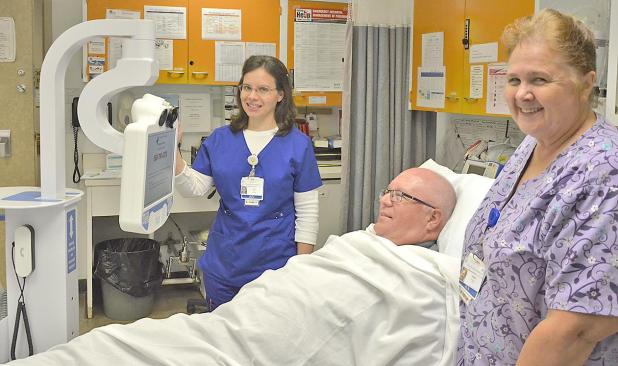
The new H1VN Telemedicine Network machine has recently been added at CCCH as a diagnostic resource for possible stroke victims coming into the ER. Pictured with the apparatus, from left, are Ann Van Lieu, RN, Steve Lewis, mock patient and Heidi Wright, RN. (Johnson Publications photo)
New diagnostic technology assists CCCH staff with stroke victims
Seconds matter for stroke victims.
Chase County Community Hospital (CCCH) has added a new telemedicine program to assist emergency room staff with assessing possible stroke patients quickly.
HealthONE Virtual Network (H1VN) Telemedicine Network is an innovative system that uses technology to bring the best of stroke and neurology care to southwest Nebraska.
“Every second counts in minimizing the damage a stroke can cause to the brain. Quick assessment and personalized care are key,” says Dr. Christopher Fanale, who developed the H1VN Telemedicine program.
“Having this state-of-the-art program puts the stroke specialist instantly in the room with a patient and ER medical provider.”
Fanale is a stroke neurologist at Swedish Medical Center (SMC) in Englewood, Colorado.
With the telemedicine technology, he can have a conversation with the patient and family, examine the patient’s ability to move and speak and even zoom in to assess pupil reactivity.
“We can talk to EMS and ER staff and assess monitors and vital signs immediately. There is no other system in the region that is currently offering this level of care to stroke victims,” Fanale said.
The H1VN allows for SMC to be linked via television monitor to emergency staff at CCCH and instantly connected to a stroke-trained neurologist.
The system allows a patient suffering from stroke-like conditions to be examined and diagnosed while still in Imperial.
“We can talk directly to the neurologist to diagnose a patient, determining the severity of a possible stroke. Hopefully it will enable us to keep more patients here instead of transporting as a first response to stroke symptoms,” said Heidi Wright, RN at CCCH.
“The H1VN will be used in conjunction with current protocol already in place as another resource,”Ann Van Lieu, CCCH RN, added.
By using this technology, CCCH staff will be able to diagnose a stroke victim quickly and determine if the severity warrants immediate intervention.
“With better and faster analysis using this equipment, a diagnosis and treatment decision can be made whether to transfer the patient or not,” said Wright.
To read more on CCCH's new telemedicine program and other stories, please log in or subscribe to the digital edition. https://etypeservices.com/Imperial%20RepublicanID359/